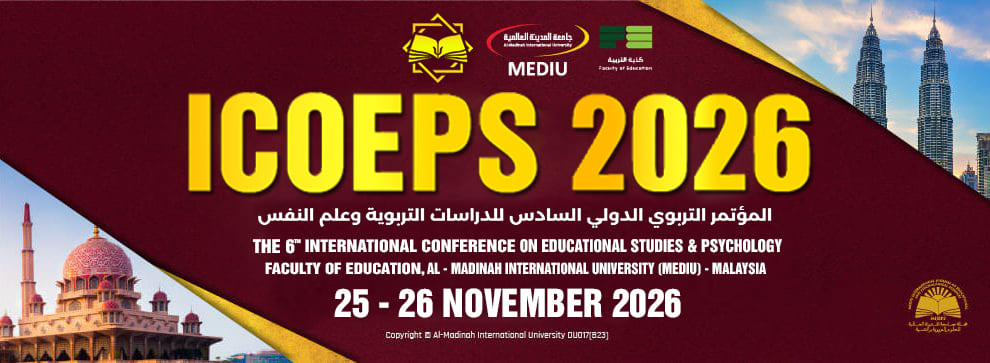
Conference Theme:
Education in the Age of Artificial Intelligence (Integrating the Human Dimension and Technology in the Development of Educational Systems)
Conference Slogan:
Toward Smart Education that Empowers Humans without Replacing Them
Organizing Body:
Faculty of Education, Al-Madinah International University – Malaysia
Conference Mode:
On-site and Online (Hybrid)
Conference Patron:
His Excellency, the Executive Director of the University, Asst. Prof. TS. Dr. Ammar Bathich
Conference Chairman:
Dean of the Faculty of Education, Prof. Dr. Ayman Aied Mohammed Mamdouh
Conference Dates:
25–26 November 2026
Conference Languages:
Arabic, English, and Malay
Conference Introduction
The world is witnessing rapid transformations driven by artificial intelligence, which have significantly impacted educational systems, learning approaches, teachers’ roles, assessment methods, and students’ skill development. This situation has made it essential to reconsider how these technologies can be integrated in ways that balance the human dimension with technological advancement, ensuring that education remains human-centered and capable of responding effectively to contemporary challenges and future aspirations.
In line with the role of the Faculty of Education at Al-Madinah International University, Malaysia, in keeping pace with global educational developments, this international conference serves as a scientific platform that brings together researchers, specialists, and decision-makers to exchange expertise and research findings on the future of education in the age of artificial intelligence.
Rationale for Selecting the Conference Theme
- The rapid development of educational artificial intelligence applications and their growing role in teaching and assessment.
- The need to understand the ethical and human dimensions of using artificial intelligence in educational institutions.
- The requirements for preparing teachers equipped with future skills and capable of effectively utilizing artificial intelligence technologies.
- The emergence of a new digital divide between educational institutions that adopt artificial intelligence and those that remain traditional.
- The need to develop educational models that balance human creativity with computational capabilities.
- Enhancing the Faculty’s position as a future-oriented academic institution.